222357, Minsk, Svobody square, 2
Reception phone number: Operating mode:from 8.00 to 13.00 and from 14.00 to 17.00 on weekdays
e-mail: This email address is being protected from spambots. You need JavaScript enabled to view it.
hotline: +375 (1772) 5-55-72


Carriers are angry about the current situation at the border and drivers remaining in Lithuania may start blocking the roads, said Erlandas Mikėnas, the head of the Lithuanian Association of Road Carriers (LINAVA), Lithuanian media report.According to him, truck drivers are extremely angry, and a decision on blocking roads in Lithuania may be made at a congress on Wednesday, 12 November.
“This decision is not up to me. Tomorrow we will hold a general meeting of members, a congress. We can sense the mood among the carriers. There are proposals for road blockades and similar actions,” Erlandas Mikėnas said today. “We are trying to calm the waters and talk to people, but I cannot guarantee what decision the association's highest governing body will make tomorrow.”Earlier, LINAVA had called on the Lithuanian government to come up with a clear action plan and to take measures as soon as possible to facilitate the return of Lithuanian vehicles and ensure the safety of drivers. In a letter to Lithuanian Prime Minister Inga Ruginienė, LINAVA said that the current situation poses a serious threat to numerous jobs and the stability of the entire transport sector.According to the State Customs Committee of Belarus, the trucks stranded in Belarus will be relocated to designated parking areas near the Belarusian border checkpoints Kamenny Log, Benyakoni, Berestovitsa and Kotlovka. The statement noted that this decision was made by the Belarusian side to ensure safety on the approach roads to the border and the security of these vehicles. Lithuania-registered trucks will not be able to cross the border until the Lithuanian side restores normal traffic across the Medininkai and Šalčininkai border checkpoints. The Belarusian border service is monitoring the situation and stands ready to respond to any changes.The Belarusian Ministry of Foreign Affairs stated that truck drivers are given the opportunity to leave Belarusian territory and return to Lithuania, leaving their trucks at the aforementioned parking sites. Drivers who are unable to leave Belarusian territory for various reasons will be provided with the necessary assistance. On 29 October, the Lithuanian authorities closed the road border with Belarus for one month. Traffic through the Šalčininkai checkpoint (Benyakoni on the Belarusian side) was completely halted, while operations at the Medininkai (Kamenny Log) checkpoint were restricted, with only specific categories of travelers allowed to cross.

Belarus’ socio-economic development program for 2026-2030 must be comprehensive, effective, and realistic, Belarusian President Aleksandr Lukashenko said at a meeting to finalize the program, BelTA has learned.

After the long weekend, around 3,000 passenger cars are waiting to enter Poland, BelTA learned from the State Border Committee of Belarus.
In a move to manage freight traffic, Belarus temporarily suspended the exit of all trucks with Lithuanian licenses as from 9.00 in the morning on 10 November, the State Border Committee of Belarus informed. The border service is monitoring the situation and remains in a constant state of readiness to respond to any changes.
Over the past three days, the Lithuanian checkpoint Medininkai (Kamenny Log on the Belarusian side) has processed the fewest number of trucks. It cleared only 16% of the normal volume of transport.
Some 250 trucks are waiting to enter the EU at the Latvian border checkpoint Paternieki (Grigorovshchina on the Belarusian side), where 31% of vehicles was checked out to enter Latvia since Friday.
630 trucks are queuing at Kukuryki (Kozlovichi on the Belarusian side) to enter Poland with. Over the past weekend, the Polish checkpoint cleared 32% of the normal number of trucks.Some 2,970 passenger cars are backed up at the Terespol border checkpoint (opposite Brest", the only one open for car traffic on the Polish side. Polish border services have processed only 32% of the usual number of vehicles for the past three days.

During a working trip to Gomel Oblast on 6 November, Belarusian President Aleksandr Lukashenko emphasized the need to create more attractive living conditions in agrotowns, BelTA has learned.It is a well known fact that villagers often seek to move to cities for more comfortable, attractive living conditions and more developed infrastructure. However, the president has repeatedly stressed that the village must not be lost under any circumstances. The state faces a critical task: to preserve the village. “You can’t drag people there with a lasso or a rope. Therefore, we must create conditions and change the system,” Aleksandr Lukashenko said. State programs for rural revival are also aimed at this. “In social terms, this means creating agrotowns. For instance, there are 14 of them in Mozyr District. These are large villages where everything should be like in a city: a kindergarten, a school, a bank,” the president said.

Ahead of the long weekend, 3,000 passenger cars are waiting to enter Poland, BelTA learned from the State Border Committee of Belarus.
“The tense situation with vehicles waiting to enter the adjacent European territory persists on the Belarus-EU border. The border services of Lithuania, Latvia, and Poland daily ignore the established norms for vehicle clearance,” the Belarusian border service emphasized.
The busiest route for trucks to enter the European Union is via the Polish checkpoint Kukuryki (Kozlovichi on the Belarusian side), with 1,490 trucks queuing. Over the past 24 hours, the Polish checkpoint cleared 64% of the normal number of trucks.
Some 790 trucks are queuing at the Lithuanian border checkpoint Medininkai (Kamenny Log on the Belarusian side). Its services processed only 14% of the usual traffic volume.
Some 360 trucks are waiting to enter the EU at the Latvian border checkpoint Paternieki (Grigorovshchina on the Belarusian side), where 26% of vehicles was checked out to enter Latvia.
A total of 3,000 passenger cars and 155 buses queuing to enter Poland near the border checkpoint Terespol (Brest on the Belarusian side), the only one available for passenger cars on the Polish border. The Polish checkpoint handled 33% of the normal number of vehicles over the past 24 hours.

Belarus President Aleksandr Lukashenko has instructed the State Control Committee to examine the market of tobacco goods and alcohol-containing products, BelTA learned from Chairman of the State Control Committee Vasily Gerasimov after the official delivered a report to the head of state.
Vasily Gerasimov said: “You know that the matter of tobacco goods has been gaining attention recently. The head of state told us everything. But all of us have been instructed to examine the market of tobacco goods and alcohol-containing products. Starting with the distribution of quotas and ending with trade in these products in the territory of the republic. We will have to take the toughest measures and report back to the head of state.”

The West rejects Belarus’ calls for dialogue and continues intensive militarization, a threat that will affect the entire CIS, State Secretary of Belarus’ Security Council Aleksandr Volfovich told the media following the annual meeting of CIS Security Council Secretaries held in Moscow on 5 November, BelTA has learned.
“One cannot ignore the situation unfolding on our western borders. Unfortunately, the West has not responded to Belarus’ calls for dialogue and constructive solutions. Instead, it continues intensive militarization, pouring huge sums in defense spending, acquiring new types of weapons and military equipment, conducting numerous exercises near the territory of the Republic of Belarus, and preparing infrastructure for combat operations, especially in border areas: they resettle the population from a 50‑kilometer zone, flood certain areas, build engineering barriers, and deploy reconnaissance equipment, effectively creating a fortified strip 50 kilometers wide along the frontier,” Aleksandr Volfovich said.“Why is this happening?
The West is preparing for war. To justify the funds invested in weapons, equipment, and infrastructure, they need an enemy. Where will they find this enemy? In the East. Who will it be? Russia and Belarus,” he noted.Aleksandr Volfovich stressed that this position was conveyed by the Belarusian side to CIS partners at the meeting. “This is not only Belarus’ problem today; this threat will affect the entire CIS,” he warned.

Belarus is ready to do everything necessary to ensure India's successful presidency of BRICS in the upcoming year of 2026, Belarusian President Aleksandr Lukashenko said as he met with Ambassador Extraordinary and Plenipotentiary of India to Belarus Ashok Kumar in Minsk on 4 November, BelTA has learned.
“We are ready to work with you under your presidency in BRICS and are prepared to do everything necessary to ensure your chairmanship is a success. We are grateful to you for the assistance and support you provided us with during our accession to the SCO, as well as for the partnership within BRICS. We gladly rely on your help and support. And you have never refused us this help and support,” the head of state said.
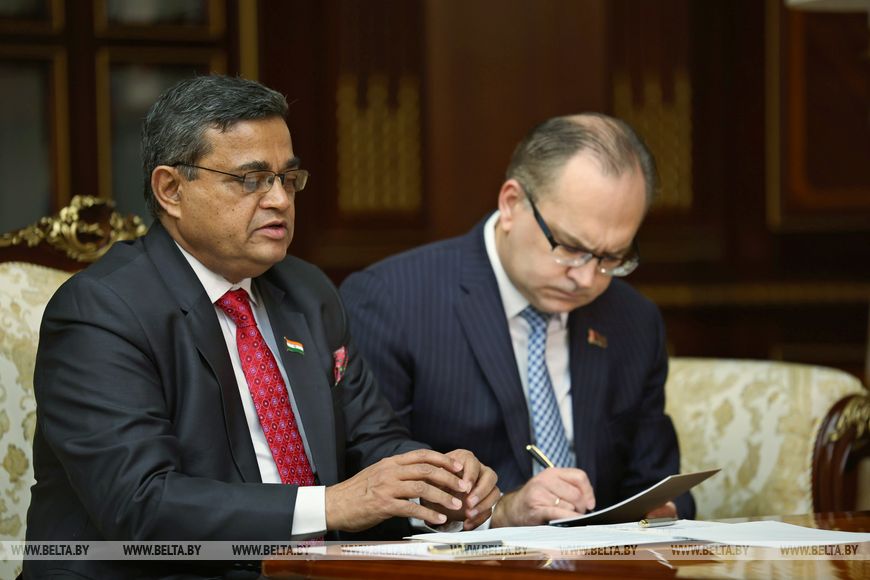
Belarus currently holds the status of a BRICS partner country. This status was officially formalized at the end of 2024 after receiving an invitation and signing the relevant document, and since the start of 2025, Belarus has officially joined the work of the organization.

2025 saw the army commission over 200 samples of weapons, military hardware, and special hardware, BelTA learned from Belarusian Defense Minister Viktor Khrenin during an educational seminar held for the army’s managerial personnel in Lepel District, Vitebsk Oblast.
Viktor Khrenin said: “In any academic year the degree, the level, and the direction of training of the Armed Forces always depend on the situation around the Republic of Belarus. Regretfully, the situation is not getting better. The tensions continue rising. We see it in actions of the leadership of the collective West, in the frantic militarization, in increased spending on military needs, on buying offensive weapons, particularly in neighboring countries. Their aggressive rhetoric towards us indicates that we need to take into account these conditions and adequately respond and train our Armed Forces.”
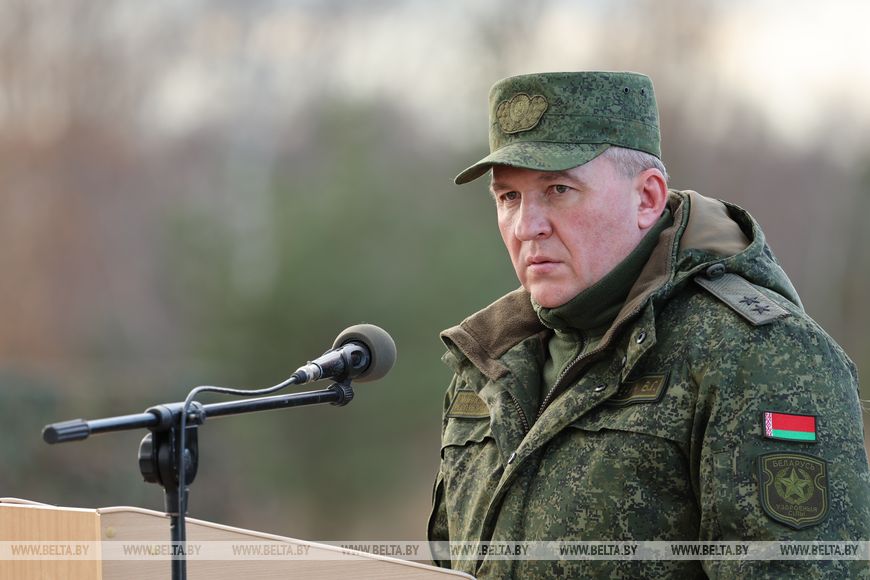

One of the accomplished tasks is the enhancement of the combat potential by increasing the combat component of the army. “It has been achieved primarily thanks to the optimization of normal activities, by means of setting up new units and enlarging the existing ones, by merging them with commands and army units, by optimizing the managerial staff. We’ve managed to accomplish a great deal in equipping our troops with modern weapon systems. This year we’ve commissioned over 200 various samples of weapons, military hardware, and special hardware. On the whole, this year the Armed Forces have received over 35,000 various samples of hardware and military technology,” the minister noted.
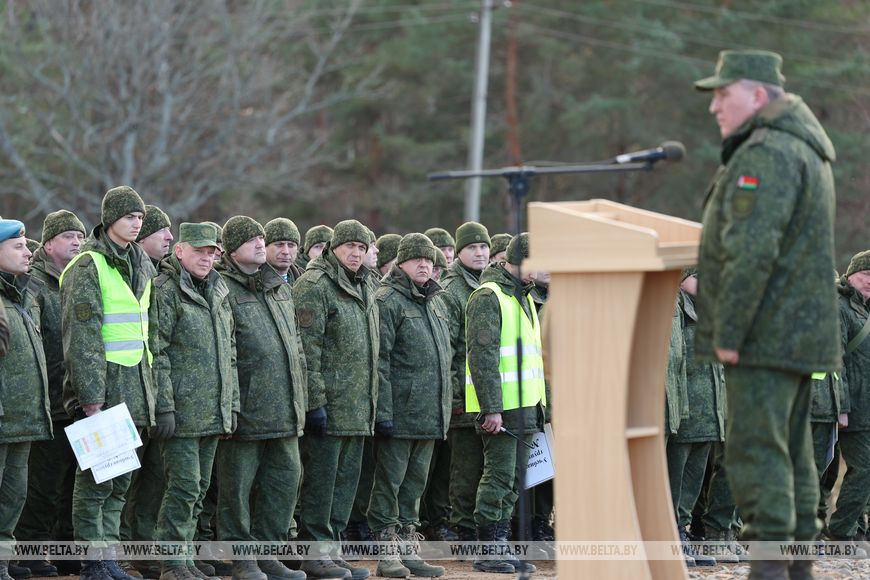
A seminar for senior personnel of Belarus’ Armed Forces took place in a military training area in Lepel District, Vitebsk Oblast on 4 November. The purpose of the seminar was to get the army officers to work out unified understanding of the sequences and methods of training functionaries of military command bodies and troops in the new academic year.

Belarusian President Aleksandr Lukashenko heard a report from Prime Minister Aleksandr Turchin on 3 November, BelTA learned.
The main topic of the report was the agenda for the upcoming visit of a Belarusian government delegation to Kazakhstan. Key current issues and promising avenues of Belarus-Kazakhstan cooperation to be discussed during the negotiations were reviewed.Cooperation with Kazakhstan was also discussed during a telephone conversation between Aleksandr Lukashenko and President Kassym-Jomart Tokayev of Kazakhstan on 29 October. The heads of state agreed that a Belarusian government delegation would visit Kazakhstan dhortly and present specific proposals for deepening cooperation.
The prime minister also reported on a number of other important and current issues.
Tourist facilities of the district
 Туристический портал Воложинского района


