222357, Minsk, Svobody square, 2
Reception phone number: Operating mode:from 8.00 to 13.00 and from 14.00 to 17.00 on weekdays
e-mail: This email address is being protected from spambots. You need JavaScript enabled to view it.
hotline: +375 (1772) 5-55-72


Belarus’ GDP went up by 1.3% in 2025, BelTA learned from the National Statistical Committee of Belarus.
According to estimates, in 2025 the GDP amounted to Br286.7 billion in current prices, up by 1.3% in comparable prices year-on-year.
The GDP deflator index was 111% compared to 2024.

On 16 January, Belarusian President Aleksandr Lukashenko signed Decree No. 19 “On crypto banks and some issues of regulation in digital tokens”, BelTA learned from the press service of the head of state.
The document aims to strengthen Belarus’ image as a leader in financial IT technologies and provides for the creation of conditions for the operation of crypto banks in the country.
According to the decree, a crypto bank is defined as a joint-stock company authorized to combine activities related to digital tokens with banking, payment, and other related financial operations.
To enter the market, a crypto bank needs to have resident status in the High-Tech Park and be included in the National Bank’s register of crypto banks.
In carrying out its activities, a crypto bank must comply with the legislation applicable to non-bank credit and financial organizations, as well as to follow the decisions of the Supervisory Board of the High-Tech Park.
This dual regulation will allow crypto banks to offer clients innovative financial products that combine the advantages of traditional banking operations with the technological efficiency, speed, and convenience of digital token transactions.

State Secretary of the Security Council Aleksandr Volfovich commented on foreign speculation claiming that the Oreshnik missile system is not present in Belarus, BelTA has learned.
“The main thing is that we are confident we have this weapon. Certainly, we hope it will never be needed. It is a weapon of deterrence, for the defense of our country. Everything required and everything agreed upon by the presidents of the two countries, has been implemented and is functioning. As for what our opponents, our neighbors say… speaking and drawing conclusions is their right,” Aleksandr Volfovich said. “It is good that they do not see this Oreshnik. And it is right.”
The state secretary noted that Russia had recently carried out a second effective use of the Oreshnik missile system. “We would not want this Oreshnik to be used from Belarusian territory. Once again, I emphasize: Oreshnik, tactical nuclear weapons deployed on Belarusian territory, are solely for the defense of our country’s territory,” he stressed.

While approving the appointment of a new rector for the Gomel State Medical University, Belarusian President Aleksandr Lukashenko recalled how he had once been advised to close this university. However, history has proven that the decision of the head of state to preserve it was correct, BelTA has learned.
“One could say it [the university] is very dear to me. Why? Because even before my presidency, there was a lot of talk. Especially when I became president, many suggested shutting it down. The reasoning was clear. We could have trained enough specialists using the existing universities in Minsk, Vitebsk, Grodno. But I felt sorry for the Gomel university. I understand that it is a regional university, serving the region, the southeast, Mogilev Oblast, and so on [by training specialists]. The students there are, let us say, more down-to-earth, in a good way. They are the ones who will largely work in the region. I felt a kind of compassion for the medical students of this university. I was quite familiar with it before my presidency, I visited it more than once as an MP. So, I said: ‘No, I cannot bring myself to shut down this university.’ And now I am convinced that this university can live and develop,” the Belarusian leader said.
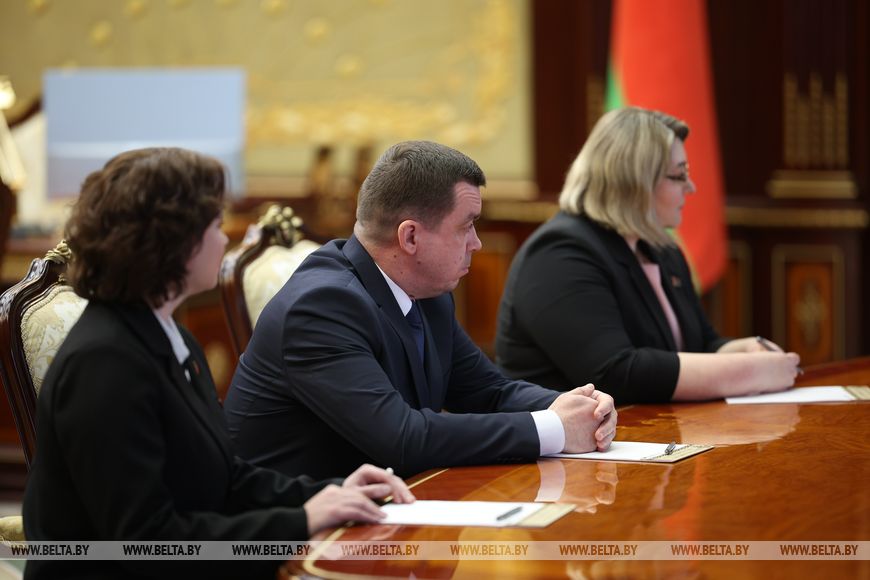
Irina Nazarenko, who has now taken over the university, expressed gratitude to the president for his support. “Gratitude is good. But you are the rector now, and you will be held to a special standard. Therefore, you must know how to work with everyone. You are all intelligent scientists, practically academicians or future academicians. You must know how to work with everyone. And find the best in people,” Aleksandr Lukashenko advised. “And do not repeat those mistakes that you sometimes made there at the university. You must treat people humanely, especially scientists.”

There is room for improvement in the social sector development, though the socially-oriented focus of the Belarusian state remains a priority, said Andrei Lobovich, who was appointed Labor and Social Security Minister by the Belarusian head of state on 15 January, BelTA has learned.
“This is my second time at the ministry. The break I devoted to working in the State Control Committee allowed me to view the development of the social sector from a slightly different angle, from the perspective of a controller,” said Andrei Lobovich. “There is definite potential for improvement in the sector. At the same time, our state’s commitment to social development remains a priority and will be enhanced further.”
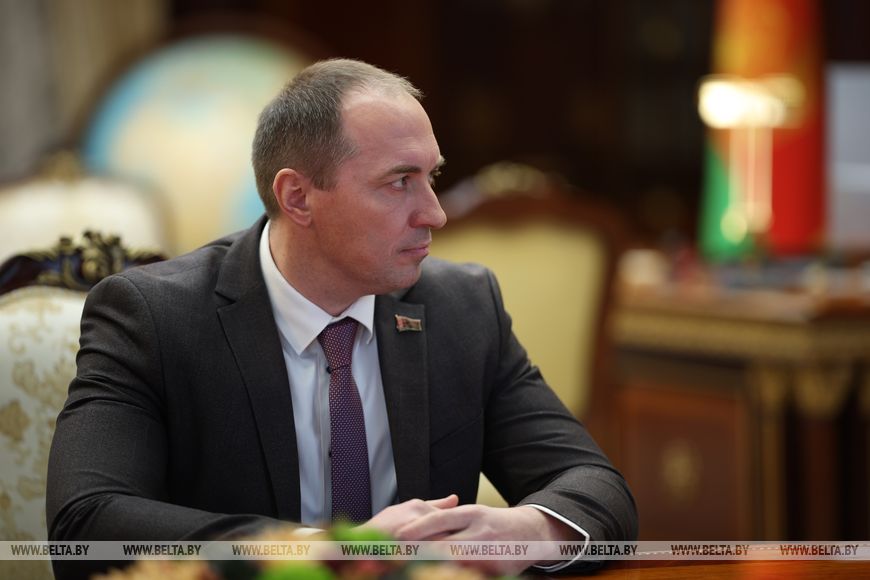
According to him, the priority will primarily involve supporting families with children, as well as socially vulnerable segments of the population.

Belarusians rallied together in cleaning up heavy snowfalls, Belarusian head of state Aleksandr Lukashenko said at the reception held on behalf of the head of state to celebrate Old New Year in Minsk on 13 January, BelTA has learned.
Addressing those present, the president stated: “In essence, we all serve the Motherland by moving Belarus forward through concrete deeds in the economy, education, healthcare, culture, sports, and public administration. This is daily work.” Aleksandr Lukashenko emphasized that representatives from all the mentioned categories did not rest during the holiday period; they remained at their posts.
“I particularly liked your drive in clearing the snow across our country. Journalists covered it in a somewhat playful way. But there is truth in this, and no small amount. That is how we should always be: united. Not whining, not moaning (although there were a few of such cases),” the head of state stated.

Key players in the European Union are unable to agree on matters of support for Ukraine, leading to discord within the EU itself, economist and analyst Serghei Banari said in the latest episode of the V Teme [On Point] project on BelTA’s YouTube channel.
Speaking on the prospects for peace negotiations concerning Ukraine, Serghei Banari pointed to Russia’s daily strengthening position and Europe’s weakening position. “Even the key players, France, the UK, and Germany, diverge on critical issues. This includes both the allocation of credit lines and the deployment of military contingents. In short, discord is beginning. The cockroaches are starting to eat each other,” said the analyst.
He suggested that this process could end with a transformation of the European Union, where a limited number of countries would begin to rebuild this alliance from scratch. “Nothing remains of what was envisioned during the creation of the Coal and Steel Community. Everything was destroyed. From a union that was supposed to build a prosperous, socially just European continent, we have seen deranged racists, chauvinists, anti-Semites, and Russophobes. Their only message is a message of death and war. They have nothing else,” the analyst emphasized.
According to Serghei Banari, membership in the European Union does not strengthen but rather weakens the sovereignty of its member states: “Absolutely unelected individuals practically trample into the mud the sovereignty, independence, and national interests of the countries participating in the European Union.”

Colonel Aleksandr Ilyukevich has been appointed Commander of the Special Operations Forces of the Armed Forces of Belarus. The previous commander, Major General Vadim Denisenko, has been retired from active duty due to age and transferred to the reserve, with the right to wear military uniform and rank insignia. Belarusian President Aleksandr Lukashenko signed corresponding decrees on 9 January, the press service of the head of state told BelTA.

As of 1 January 2025, a total of 151,242 large families have opened deposit accounts in Belarus under the family capital program, including 82,600 deposit accounts to the total amount of $826 million and 68,600 deposit accounts totaling Br1.83 billion, BelTA learned from the press service of the Belarusian Labor and Social Security Ministry.
As of 1 January 2026, a total of 101,650 families applied for permission to use family capital ahead of schedule. Of them, 81,495 applied to use the money to improve housing conditions, 11,083 to pay for healthcare services, 9,065 to pay for education and seven to buy health products for disabled people.
The ministry granted permission to use family capital earlier to 98,649 applicants. The regional breakdown is the following: Brest Oblast (20,859 families), Vitebsk Oblast (9,581), Gomel Oblast (15,807), Grodno Oblast (11,791), Minsk Oblast (16,921), Mogilev Oblast (9,953) and the city of Minsk (13,737).
The Labor and Social Security Ministry noted that the family capital program applies to families raising three and more children.
The new amount of family capital, effective from 1 January 2026, will be published on the official website of the ministry by 31 January 2026. In 2025, it amounted to Br33,275.

Belarusian President Aleksandr Lukashenko has approved decisions on border security in 2026, BelTA has learned.
These decisions pertain to border security, which falls under the border service agencies, and airspace security.

Aleksandr Lukashenko noted that approving border security decisions at the highest level at the start of the year is a well-established military tradition. “Today, [countering threats to border security] is more relevant than ever,” he said.

The situation around Belarus is not becoming calmer, Aleksandr Lukashenko said. “We have always been in a very serious situation. Today, unfortunately, the trend shows that things are not calming down. Looking at the map, we see that we are practically surrounded by military units on all sides. The only relief is the eastern border with the Russian Federation, where conditions are somewhat easier. Yet I would not say the situation is simple, especially given recent events in Ukraine, when drones can enter our territory from unpredictable directions. Frankly speaking, we have not yet learned to respond fully to these incursions, nor to destroy them completely. I am not sure whether achieving 100% effectiveness is possible, but it is a goal we must strive toward,” the head of state said.


