222357, Minsk, Svobody square, 2
Reception phone number: Operating mode:from 8.00 to 13.00 and from 14.00 to 17.00 on weekdays
e-mail: This email address is being protected from spambots. You need JavaScript enabled to view it.
hotline: +375 (1772) 5-55-72


Belarusian President Aleksandr Lukashenko has congratulated veteran border guard, participant of the Great Patriotic War and retired Colonel Vasily Davzhonok on a significant milestone - the 100th birthday, BelTA learned from the press service of the Belarusian leader.“From early youth you defended your homeland with weapons in your hands in the ranks of partisans and underground fighters at first and then as member of the border troops,” the head of state emphasized.
The president noted that Vasily Davzhonok has a long life journey as a person, a citizen, and a warrior, having devoted many years of his life to border service, being an honoree of numerous state awards. “You are a participant in the legendary partisan parade in Minsk in July 1944. A representative of that heroic generation of Victors, for whom serving the Fatherland was the goal and meaning of life,” the congratulatory message said.The head of state expressed his most sincere gratitude and appreciation for the fact that, despite the years and hardships, Vasily Davzhonok is still active and finds opportunities to meet with border guard cadets. “Such resilience, fortitude, and love of life are admirable and serve as an example to all of us,” the Belarusian leader noted.
Aleksandr Lukashenko wished Vasily Davzhonok strong health, wellbeing, vigor, and positivity: “May each new day bring you only good and kind things.”

The military agencies of Belarus and Vietnam have discussed matters of military-technical cooperation and strengthening ties during an official visit of Chief of the General Staff of the Armed Forces – Belarusian First Deputy Defense Minister Pavel Muraveiko to Vietnam, BelTA learned from the press service of the Belarusian Defense Ministry.
Pavel Muraveiko held negotiations with Chief of the General Staff of the Vietnam People’s Army Nguyen Tan Cuong. During the meeting, the parties discussed the international agenda and detailed their military cooperation in areas of mutual interest, stressing the need to elevate their interaction to a qualitatively new level: a strategic partnership.
The head of the Belarusian military delegation also met with Vietnamese Minister of National Defense Phan Van Giang. The parties confirmed their interest in strengthening close ties. A wide range of issues were discussed, including military, military-technical, trade and economic cooperation.

During a tour of the Minsk City Technical Creativity Center for Children and Youth Belarus President Aleksandr Lukashenko talked to students of this institution and appreciated the products they presented, BelTA has learned.
Aleksandr Lukashenko welcomed the kids by saying: “Good day, Kulibins! [Ivan Kulibin was a famous Russian inventor] Does anyone of you know who Kulibin was and what he did? This is a homework assignment for you. Report the results to the Minsk mayor. He will pass them on to me.”
The president encouraged students of the Minsk City Technical Creativity Center for Children and Youth to further develop their abilities. In turn, the state will enable the necessary conditions for it. “Guys, thank you very much. Make something useful, something strong for the country. May success attend you. If you have any problems, speak up. But keep in mind that you will still have to deal with tasks and problems. We will enable conditions for you to handle them like you do it here. It is a good building [where the technical creativity center is located] for you to make initial attempts,” the head of state said.

Belarus’ Ministry of Foreign Affairs has expressed its deep condolences over the death of RIA Novosti correspondent Ivan Zuev, BelTA learned from the press service of the Ministry of Foreign Affairs of Belarus.
"The death of a journalist who was performing his professional duty in a conflict zone is a stark reminder of the high risks faced by media representatives in conflict areas," the Ministry of Foreign Affairs noted.
The ministry recalled that international humanitarian law explicitly stipulates that journalists reporting in situations of armed conflict are considered civilians and are not legitimate military targets. An attack on them constitutes a war crime.
"Cases of attacks on media representatives, who are marked in accordance with international standards, demand the most decisive response and effective measures from appropriate international organizations,” the Ministry of Foreign Affairs emphasized.
The ministry also extended sincere wishes for a speedy recovery to cameraman Yuri Voitkevich, who was injured in the same attack.

Agricultural workers must complete autumn fieldwork on time, Belarusian President Aleksandr Lukashenko said at a meeting to discuss draft forecast documents for the coming year on 16 October, BelTA has learned.
The president highlighted pressing challenges in agriculture, a vital sector of the domestic economy.
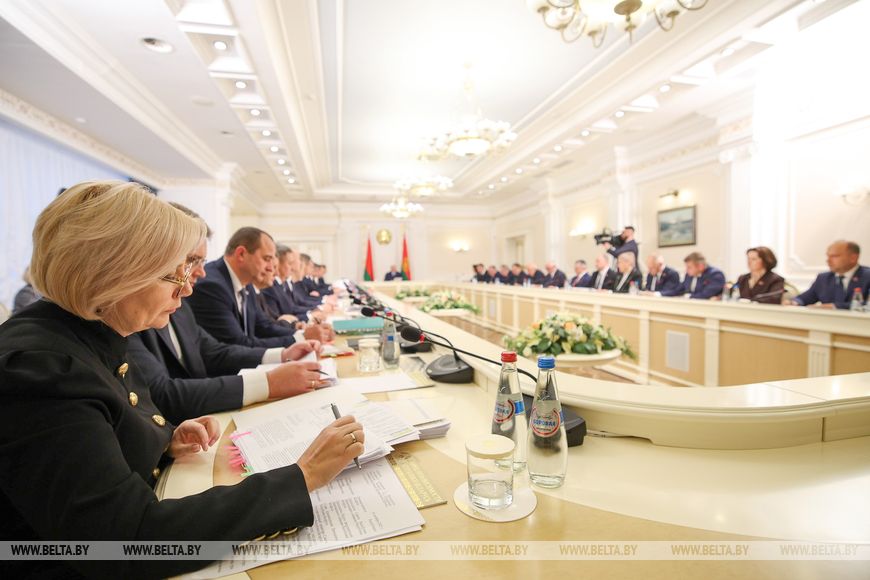
Aleksandr Lukashenko emphasized that it is critically important to complete essential autumn fieldwork on time. This includes harvesting, plowing fallow land, applying fertilizers, and preparing the soil for the next season.
“Frost is coming. Without plowing and fallowing now, we’ll face a disaster in the spring that will wipe out any chance of a harvest. We have no choice but to work day and night, starting today,” the head of state emphasized.
During the meeting, the president requested detailed updates on the harvest campaign’s progress across all regions. He focused particularly on Grodno Oblast, a traditionally high-performing agricultural region, where the unfinished harvest of certain crops this year is an unusual development. Governor Yuri Karayev had to answer critical questions from the president, specifically regarding the ongoing sugar beet and corn harvests. With corn still in the fields and losing quality, the president ordered an immediate harvest and processing into crimped feed. He stressed that this approach ensures stable storage and high-quality livestock feed, adding that Belarus is fully equipped with the necessary crimping machinery.
The head of state praised Minsk Oblast for its strong performance: “Minsk Oblast is performing well this year, even though it is a challenging region.” Conversely, he warned the leadership of Gomel Oblast and Vitebsk Oblast that the situation in their agricultural sectors would be scrutinized, particularly the measures taken to address recent livestock losses.

Belarus has achieved one of Europe’s and the world’s lowest infant mortality rates, Dmitry Lazar, Deputy Head of the Directorate for Medical Care Provision – Head of the Department of Medical Care for Mothers and Children at the Healthcare Ministry, told BelTA’s Nation Speaks project.
“The maternal mortality rate currently does not exceed 1.5 cases per 100,000 live births. In 1993, that figure stood at 20.4. This represents a dramatic improvement from 1993, when the rate was 20.4. Such progress positions Belarus among leading nations like Israel, Poland, and Finland. Furthermore, we also maintain one of the lowest infant mortality rates globally. The 2024 rate of 2.9 per 1,000 live births comes in below the global average of 3 per 1,000. We have kept it below the global average for many years already,” the healthcare official said.
He explained that each case of maternal or infant death is reviewed by treatment control councils at both the regional and national levels. “Problems are always identified and resolved immediately. We monitor severe cases daily; I personally track every case when a child gets in intensive care in critical condition, and a team is dispatched there immediately. We work closely with the regions. The healthcare system has a multi-tier structure: The National Research and Treatment Center Mother and Child serves as the fourth, top tier. The third tier consists of regional healthcare facilities, while the first tier comprises district hospitals. A system of inter-district centers constitutes the second tier, creating a comprehensive network. In Minsk Oblast, for example, these centers are in Soligorsk, Molodechno, and Borisov. By concentrating top-notch equipment and highly qualified specialists at these centers, we ensure that critically ill patients are directed to the appropriate facility and receive the care they need.”


