222357, Minsk, Svobody square, 2
Reception phone number: Operating mode:from 8.00 to 13.00 and from 14.00 to 17.00 on weekdays
e-mail: This email address is being protected from spambots. You need JavaScript enabled to view it.
hotline: +375 (1772) 5-55-72

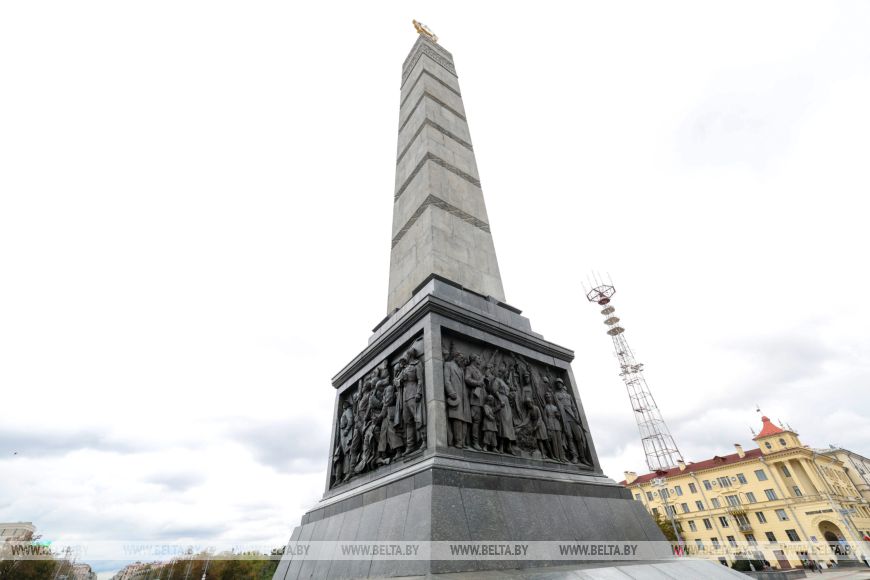
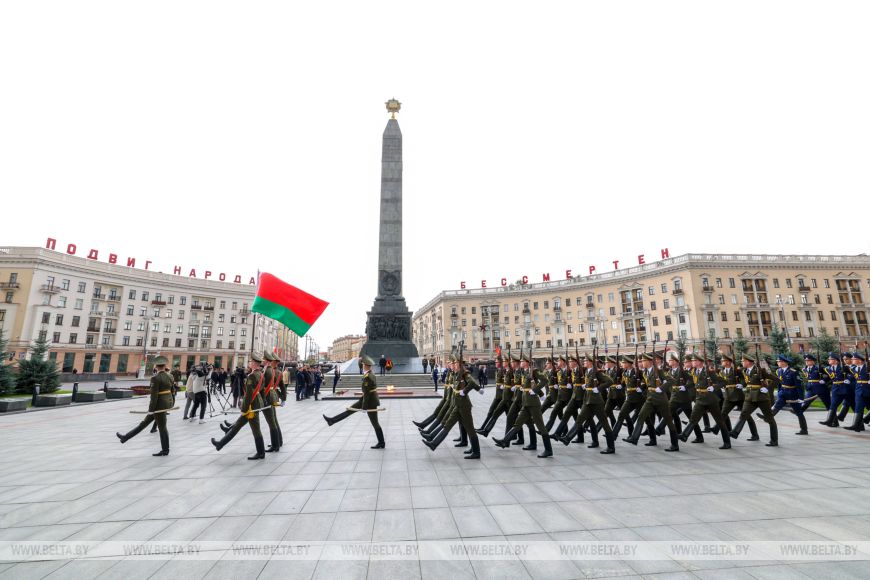
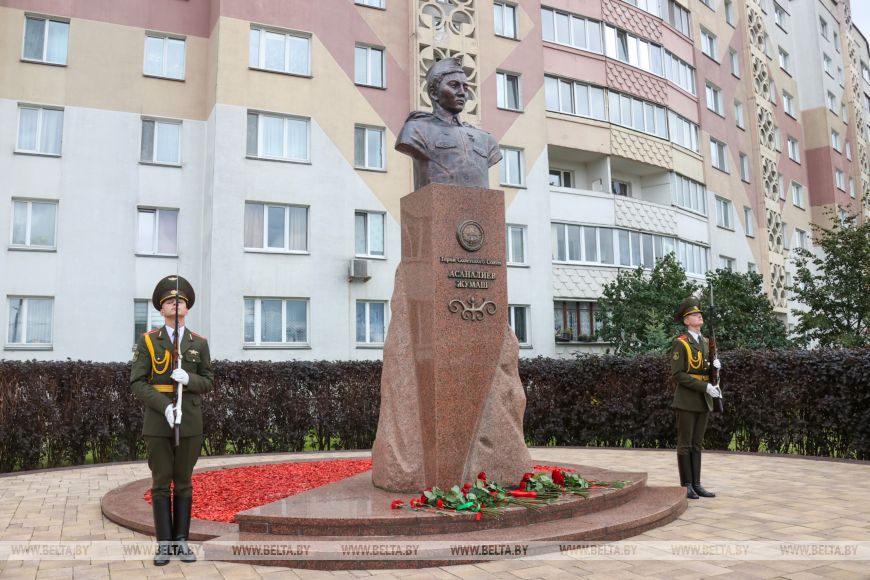
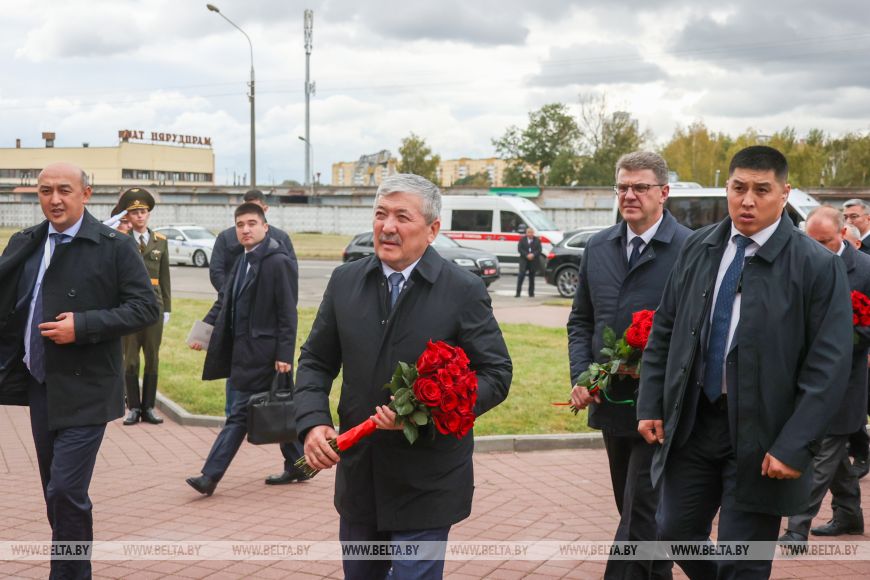
Chairman of the Cabinet of Ministers and Head of the Presidential Administration of the Kyrgyz Republic Adylbek Kasymaliev arrived in Belarus on an official visit on 28 September. Upon arriving in Minsk, he took part in a ceremony to lay wreaths and flowers at the Victory Monument and the monument to Hero of the Soviet Union Jumash Asanaliev.
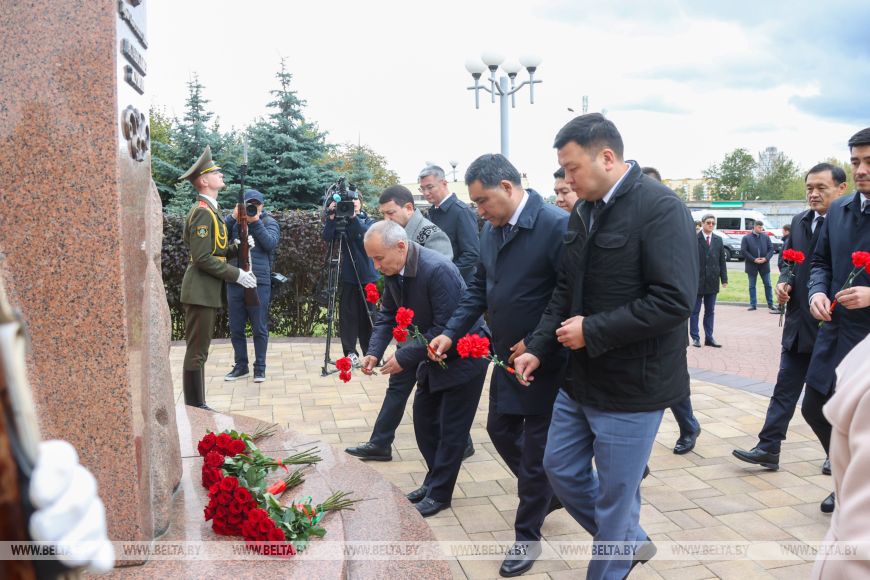
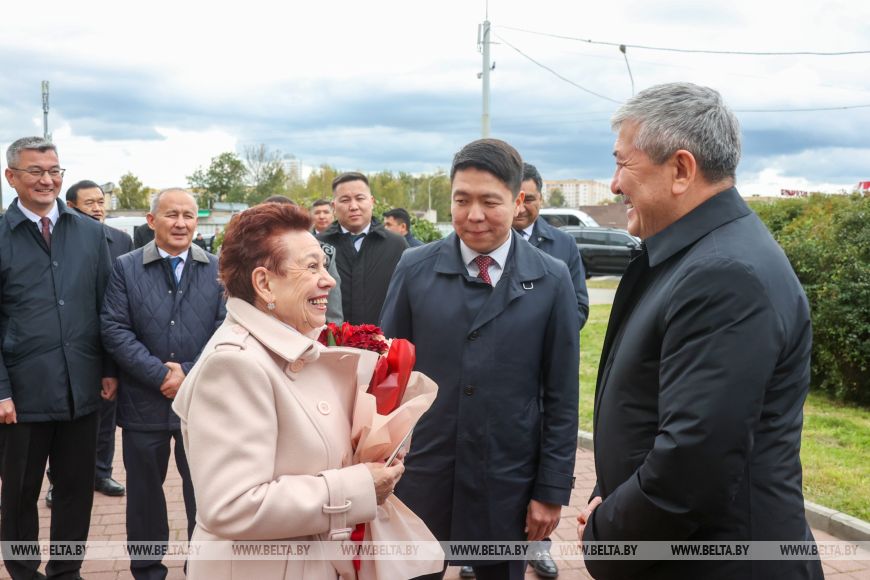
Photos courtesy of the press service of the Government of the Kyrgyz Republic, Vitaly Pivovarchik, Sergei Sheleg
The policy of the Polish leadership is based on the Jagiellonian concept, which implies expansion to the east and confrontation not only with Russia but also with Germany, Andrei Bogodel, Deputy Head of the Faculty of Education and Science – Head of the Education and Methodology Department of the Faculty of the General Staff of the Armed Forces at the Military Academy of Belarus, said in the latest episode of the V Teme [On Point] project on BelTA’s YouTube channel.
According to the expert, the policy of the Polish leadership is based on the Jagiellonian concept, which implies, among other things, expansion to the east and confrontation with Russia. “On one hand, this concept is aimed at pitting Poland against Russia, and on the other hand, against Germany. The essence of this idea is that Poland needs to regain the lands from Belarus and Russia that they allegedly should not have,” he emphasized.
Nevertheless, Andrei Bogodel believes that the militarization of Poland is directed not only against Belarus and Russia. They are also trying to use Poland as a counterbalance to Germany in order “not to let it get too strong.” “If we return to the Jagiellonian concept, the Poles realize that Russia certainly has no time for Poland right now. But Germany, which is growing significantly in strength and influence, has its own claims against Poland. We are hearing more and more talk there about the need to switch from a professional army to a conscript one,” the expert said.
The Embassy of the Republic of Belarus in the Republic of Korea hosted an annual cultural event, Belarusian Cuisine Day, organized in cooperation with members of the Belarusian diaspora, BelTA learned from the Belarusian Embassy in Seoul.
Attending the event were students from the Russian language department at Chungbuk National University, local cultural figures, civil society representatives, and members of the media.
Ambassador Extraordinary and Plenipotentiary of Belarus to the Republic of Korea Andrei Chernetsky addressed the guests with a welcoming speech. He emphasized the importance of preserving national traditions and values, spoke about Belarus’ rich culinary heritage, and highlighted the momentum in Belarus-Korea cooperation across various sectors.
The State Border Committee of Belarus has received an official notification from the Border Guard of the Republic of Poland about the reopening of border checkpoints on the Belarusian-Polish border during the upcoming night, BelTA learned from Anton Bychkovsky, an official representative of the State Border Committee of Belarus.
“An official notification has been received by the State Border Committee from the Border Guard of the Republic of Poland about the reopening of the checkpoints on the Belarusian-Polish border that were closed almost two weeks ago. The border checkpoints will start operating from 01:00 on 25 September Belarusian time,” Anton Bychkovsky said.
In his words, reopening will be the road border crossing points Brest-Terespol and Kozlovichi-Kukuryki, as well as four railway checkpoints: Grodno-Kuźnica Białostocka, Berestovitsa-Zubki Białostockie, Svisloch- Siemianówka, and Brest-Terespol.
China's first-ever World Rowing Championships kicked off in Shanghai on Sunday, with over 1,000 athletes from 55 countries and regions set to compete in the Qingpu district of the East China metropolis.
The championships, organized by World Rowing, the sport's international governing body, and set to run until Sept 28, represent Shanghai's highest-level single-sport world championships this year, as well as being the city's first integrated international competition for both able-bodied and para athletes.
Rowers will vie for medals across 23 boat classes at the Shanghai Water Sports Center, which features a competition-standard 2,250-meter, eight-lane course.
According to the official website of World Rowing, the men's single sculls has emerged as the most popular event with 36 teams participating, while the women's single sculls has drawn 20 teams. The PR3 mixed double sculls in the para-rowing has reached a record 14 entries.
The 2025 championships will introduce the mixed double sculls with 11 entries, while the mixed eight, previously tested at the 2025 World Rowing Cup in Varese, Italy, in June has attracted 10 entries. China is featured in 20 of the 23 classes.
Olympic champions will headline the competition, including Chinese stars Chen Yunxia and Zhang Ling, who claimed gold in the women's quadruple sculls at the Tokyo 2020 Olympics and won the two World Cup events this year.
Early on Sunday, Chinese fans already had reasons to be cheerful as Li Yawei and Sun Man won their lightweight men's double sculls preliminary race, as did Zou Jiaqi and Fu Ling for the women in the same class.
The men's quadruple sculls saw the Chinese quartet of Wang Jia, Mu Xiaolong, Liu Baishun and Zhang Quan book their place in the semifinals on Tuesday.
Monday will see Chen Yunxia and Zhang Ling take to the water in the heats for the women's double sculls, Han Wei contest the men's single sculls heats, as well as action for Chinese teams in the men's and women's fours. On the para-rowing side, Shao Shasha is set to line up for the PR1 women's single sculls preliminaries.
"We've renovated the competition venue according to World Rowing's standards," Liang Li, deputy director of Shanghai sports training base management center, said.
The venue features enhanced accessibility, including shortened pathways from boat houses to docks, wheelchair-friendly ramps, and convenient rest areas.
"We have upgraded all the barrier-free facilities to provide the best support for para athletes," Liang noted.
Safety measures include six rescue boats, while spectator facilities feature a 2,000-seat main grandstand equipped with sun protection and electronic screens for live coverage.
Vincent Gaillard, executive director of World Rowing, expressed his excitement about the event: "It is not the first time we have come here, but this time it's getting very serious. All the indicators are great. We're going to have a landmark and benchmark world championships.
"The cooperation between World Rowing and Shanghai has been exceptional. The preparation is very professional and well-organized. We're in the city that combines both the heritage of the past with the future of rowing," he added.
There were no major strategic or operational problems during Zapad 2025 military exercise, Chief of the General Staff, First Deputy Defense Minister of the Republic of Belarus Pavel Muraveiko said on the air of the STV TV channel, BelTA has learned.
According to Pavel Muraveiko, preparing and conducting the exercises is similar to shooting a high-quality feature film. “It's not because there's a script and the actors follow a predetermined plan. No, objectives and tasks are determined, and the format for deploying troops is chosen, whether it's a defensive operation, a special operation, or actions to eliminate sabotage and reconnaissance groups, or to secure the border. Based on that framework, key episode scenarios are chosen for simulation. The difference is that participants don’t know how the situation will evolve. They’re given only minimal information, just enough to experience events as ordinary citizens would,” he explained.
He gave an example of initial conditions: sabotage and reconnaissance groups crossing the border. “Naturally, the commander tasked with responding begins to analyze the situation, assess the terrain, make decisions, calculate available forces and resources, and determine which directions need to be secured. He decides what firepower to use against the sabotage group or illegal armed formation to prevent its escape. Then he determines how to block it, so it can be arrested or neutralized. All of this happens in his mind: he works it out on maps. The exercise director observes the process and makes adjustments as needed,” Pavel Muraveiko said. He added that the exercise simulation resembles a chess match, where each participant plays a specific role and task, and the entire process is as close to real combat conditions as possible.
Pavel Muraveiko also noted that if participants somehow find out about the assignment in advance or get hints, adjustments are made, but he emphasized that this has not happened during the recent exercise. “In the past 10-12 years of conducting exercises, we haven’t seen such cases at all. That’s because commanders themselves are truly interested in learning through real actions,” he remarked. “They often say: who knows, maybe you did me a disservice?”
Warsaw's claims that drones flew into Poland from Russia are refuted by a number of objective facts, Nikolai Buzin, Member of the House of Representatives of the National Assembly of Belarus, pointed to these inconsistencies in a recent episode of the V Teme [On Point] project on BelTA’s YouTube channel.
When asked how to treat official Warsaw's statements about the UAVs that breached Polish airspace, Nikolai Buzin said they should be perceived calmly. “There is a fairy tale about a boy who was herding sheep and cried wolf when there wasn't one. And when the wolves actually came, no one helped him,” the MP recalled.
In his opinion, the European Union and Poland have behaved like the boy from that fairy tale in this drone situation. Furthermore, he noted, Warsaw has already tried to play this same card. This was the case, in particular, in 2022 when a Ukrainian S-300 missile fell on Polish territory.
“In this regard, I like our president's statement: yes, a war is going on near us. It’s possible that malfunctioning or ‘lost’ drones could enter our territory as well. No one is immune to this,” said Nikolai Buzin.
According to him, these UAVs simply could not have flown from Russian territory to Polish territory based on their technical characteristics (including their fuel supply). Moreover, the drones were not loaded with explosives. “Tell me, please, what state would deliberately launch a drone without a warhead, intending to cause damage to an adversary?” Nikolai Buzin asked a logical question.
The expert also drew attention to the fact that the West has not published any technical control data of the flight showing its trajectory. “If the West had such information, believe me, they would use it to the fullest. After all, by claiming that we are preparing to attack them, they are providing no proof. If Western states, including Poland, possessed such information, they would use it to the maximum extent,” Nikolai Buzin said.
Law enforcement agencies of Belarus and China have discussed priority areas of joint activity, BelTA learned from the Belarusian Ministry of Internal Affairs.
Belarus’ Interior Ministry delegation, led by its First Deputy Minister - Head of the Public Security Police Yuri Nazarenko, attended the Global Public Security Cooperation Forum. The event brought together about 2,000 experts from various countries and international organizations in Lianyungang, China.
The agenda included addressing risks and challenges to global public security, technological cooperation in police training, immigration management, tourism security, countering terrorism and transnational crime, and drug trafficking, among other issues.
Director of the Political Department of China’s Ministry of Public Security Jia Lijun
On the sidelines of the forum, Yuri Nazarenko held bilateral talks with the senior officials of the Ministry of Public Security of China. Yuri Nazarenko expressed confidence that the July meeting of Belarusian Interior Minister Ivan Kubrakov and Chinese Minister of Public Security Wang Xiaohong will help strengthen the partnership between the Belarusian Ministry of Internal Affairs and the Chinese Ministry of Public Security. The parties discussed priority areas of joint work and paid special attention to the operation of the Police Cooperation Center established at the China-Belarus Great Stone Industrial Park, which serves as an example of successful interaction between the two countries.
Belarus marks the Day of people’s Unity on 17 September. The holiday was instituted on 7 June 2021 by Belarusian president’s Decree No.206.
The holiday celebrates the beginning of the Red Army's liberation campaign in Western Belarus in 1939, which resulted in the reunification of the Belarusian people, divided under the terms of the Treaty of Riga.
The territory of Belarus was divided between the two states as a result of the Polish-Soviet War of 1919-1920. The eastern part of Belarus became the Byelorussian Soviet Socialist Republic, part of the USSR. The western territories of Belarus were annexed to Poland - some of the lands were seized by the Poles during the war, and some of them were agreed under the Treaty of Riga, signed on 18 March 1921.
The Polish state included the territory of more than 112,000 square kilometers with a population of 4.6 million people (according to 1931 data). These lands were given the unofficial name of Western Belarus, which the Polish authorities did not recognize. In official documents, these territories were more often called Kresy Wschodnie.
Western Belarus was a relatively backward agrarian outskirt of Poland. The region was mainly used by the state as a source of raw materials and cheap workforce. The working day in industry lasted for 10-12 hours, salaries were lower than in the other Polish regions. More than 80% of the region's population was engaged in agriculture.
The Polish authorities pursued a policy of polonization and assimilation against Belarusians. They prohibited the use of the Belarusian language in state institutions and banned Belarusian schools. Out of 400 Belarusian schools that operated on the territory of Western Belarus before the Polish occupation, only 16 remained in 1934, and none was left in 1939. The Belarusian press was persecuted. If there were 23 Belarusian newspapers and magazines legally published in 1927, then in 1932 there were eight of them, and only pro-Polish and clerical publications remained until 1937. There were no Belarusian theaters and musical institutions in Western Belarus. The authorities found various reasons to close Belarusian publishing houses, libraries and village reading rooms.
The main method the Polish government used was coercion and often terror. Mass police repression of the population during punitive expeditions to subdue farmers uprisings was commonplace. Political trials were a regular thing. Prisons were used to isolate “socially dangerous elements”. The Bereza Kartuska concentration camp was established in 1934. According to incomplete data, the camp saw more than 10,000 prisoners over the five years of its operation.
The Belarusian people have never accepted the situation they got in. For 20 years Belarusians fought for social and national liberation, and their struggle took different forms at different times, but never ceased. Workers’ and farmers’ demonstrations were a common thing at that period. Cultural and educational organizations, with the Belarusian School Association to be the leading one, made their considerable contribution. The Communist Party of Western Belarus was at the head of the revolutionary movement for many years.
In the late 1930s, the threat of war from Nazi Germany loomed over the entire Europe. The situation required joint actions from the leading countries of Western Europe and the USSR to prevent the war. Realizing this, the Soviet Union made a number of attempts to set up an anti-Hitler alliance with the UK, France and other Western countries in the second half of the 1930s. However, the leading European states refused the offer, secretly seeking to direct Hitler’s aggression eastward. The Soviet Union was faced with a choice: either to continue a one-on-one confrontation with Germany's growing military power, or to make attempts to diplomatically ward off the threat. Under such circumstances, the USSR concluded a nonaggression pact with Germany, which was signed in Moscow on 23 August. The document was accompanied by an additional secret protocol on the division of spheres of influence between Germany and the Soviet Union. According to this document, in the event of the liquidation of the Polish state and the division of its territories, the USSR’s sphere of influence included the lands of Western Belarus.
On 1 September 1939, Hitler’s Germany attacked Poland. The Second World War began. German divisions crossed the border in several directions and began to advance rapidly deep into the Polish state. Its government and commanders were unable to organize an effective defense and abandoned the country in the third week of the war.
In mid-September, German troops approached the territory of Western Belarus and Western Ukraine. The German leadership, referring to the agreement of 23 August, hurried the Soviet Union to act against Poland. Stalin, however, was delaying the intervention. Only when the Polish army was defeated, practically all the original Polish territories were occupied by German troops, and only isolated points of resistance remained in the country, did the Soviet government order the Red Army to cross the border.
On the morning of 17 September, the Polish Ambassador in Moscow received a note from the Soviet Government. It said: “The Polish-German War has revealed the internal instability of the Polish State. During 10 days of military operations Poland has lost all its industrial regions and cultural centers. Warsaw as the capital of Poland no longer exists. The Polish Government has scattered and gives no signs of life. This means that the Polish State and its Government factually have ceased to exist. By this fact in itself treaties concluded between the Union of Soviet Socialist Republics and Poland have lost their validity. Left to shift for itself and left without leadership Poland has become a convenient field for all kinds of eventualities and unforeseen contingencies which may constitute a threat to the Union of Soviet Socialist Republics. Therefore having been heretofore neutral the Soviet Government can no longer adopt a neutral attitude to these facts. The Soviet Government can also not be indifferent to the fact that the consanguine Ukrainians and Belarusians living on the territory of Poland who have been left to the whim of fate should be left defenseless. In view of this situation the Soviet Government has issued instructions to the Red Army High Command to give the order to its forces to cross the Polish border and take under their protection the life and property of the population of Western Ukraine and Western Belarus.
The note was signed by Molotov, People's Commissar for Foreign Affairs of the USSR. He also made a radio address to the Soviet people.
The advance of the Soviet troops was rapid: on 18 September they occupied Sventyany, Lida, Novogrudok, Slonim, Volkovysk; and Pruzhany and Kobrin on 19 September.
Most units of the Polish Army surrendered without a fight. The units that included mostly ethnic Ukrainians and Belarusians, went over to the side of the Red Army. They were immediately sent home. Polish officers and policemen were sent by echelons to Soviet camps.
The main part of the population of Western Belarus welcomed the Soviet soldiers with joy and rendered effective assistance. Military and revolutionary committees were set up in many places to organize detachments of workers and farmers. These formations disarmed the police, took under guard bridges, enterprises and other important facilities.The battle for Grodno lasted for several days. About 3,000 soldiers and officers of the training unit and policemen put up a resistance here. On 20 September the city was taken, and on 22 September Soviet troops entered Brest-Litovsk and Bialystok.
With the arrival of the Red Army new authorities started forming in voivodeships and district capitals. Those were temporary administrations in cities and village committees in towns and villages. They took care of implementing the first reforms, and then of organizing elections to the People’s Assembly of Western Belarus, which was supposed to decide on the main aspects of the state system. The elections were held on 22 October 1939 in a situation of political upsurge.
The People’s Assembly of Western Belarus convened in Bialystok on 28-30 October 1939. It adopted a declaration on the proclamation of Soviet power and on the incorporation of Western Belarus into the BSSR. On 2 November 1939 the extraordinary 5th session of the first-convocation USSR Supreme Council decided to grant the request of the People’s Assembly of Western Belarus and to incorporate Western Belarus into the USSR and unite it with the Belarusian SSR. The final legislative act was the adoption of the law “On the admission of Western Belarus to the Belarusian Soviet Socialist Republic” by the extraordinary 3rd session of the BSSR Supreme Council on 14 November 1939. In this manner the republic’s territorial integrity was restored and the Belarusian nation was reunited.
The territory and the population of the republic almost doubled. Baranovichi Oblast, Bialystok Oblast, Brest Oblast, Vileika Oblast, and Pinsk Oblast were formed in the Western Belarus lands that had become part of the BSSR. These regions were involved in radical social and economic transformations. Enterprises and banks were nationalized, collectivization and mechanization of agriculture were carried out. Radical changes took place in education, healthcare, science, and culture. The work on liquidation of illiteracy was intensified. Educational institutions were set up for different ethnic groups of the population: as many as 4,192 Belarusian, 987 Polish, 173 Russian, 168 Jewish, 63 Lithuanian, 43 Ukrainian schools operated in the western regions of the BSSR in 1941. Theaters, 100 cinemas, 92 houses of culture, 220 libraries were opened. Belarusian-language press began circulating in all the oblast capitals and district capitals. The progressive development of economy and social sector of the western regions of the republic was interrupted by the start of the Great Patriotic War of 1941-1945.
The unconditional priority of legislative activity is ensuring the independence and defense capability of the state, Chairman of the House of Representatives Igor Sergeyenko said as he opened the third session of the House of Representatives of the National Assembly of the Republic of Belarus of the eighth convocation in Minsk on 16 September, BelTA has learned.
“The absolute priority of legislative activity is ensuring the independence and defense capability of the state,” Igor Sergeyenko said.
Belarus has always been a donor of regional security. Belarus does not need war. This is evidenced by the peaceful foreign policy of the country, the approved Concept of National Security and the Military Doctrine, which are purely defensive in nature.
“At the same time, we see what is happening on the Belarusian borders and in the European region as a whole. A large-scale process of militarization is underway, and our immediate neighbors – Poland and the Baltic states – are purposefully turning into NATO’s foothold. All this creates direct military threats both for Belarus and for the Union State,” Igor Sergeyenko said


