222357, Minsk, Svobody square, 2
Reception phone number: Operating mode:from 8.00 to 13.00 and from 14.00 to 17.00 on weekdays
e-mail: This email address is being protected from spambots. You need JavaScript enabled to view it.
hotline: +375 (1772) 5-55-72

The Union State of Belarus and Russia stands ready to counter threats coming from the West, Chairman of the House of Representatives of the National Assembly of Belarus Igor Sergeyenko said at the session of the Parliamentary Assembly of the Union State of Belarus and Russia in Moscow on 9 December, BelTA has learned.
“We are going through a difficult period of history when not only the future of the Union State but also the fate of the whole world depends on our efforts. Today NATO countries are openly preparing for a major war, implementing detailed plans for rearmament, building up relevant infrastructure and logistics. The alliance is stepping up its military presence near our western borders, and even discussing the possibility of launching preventive strikes against Russia,” Igor Sergeyenko said.
“We stand ready to counter these threats. The ratification of the Union State security guarantees treaty this year authorizes the employment of the full range of available forces and capabilities to defend against any potential external threat,” the chairman of the House of Representatives stated.
“Issues of protecting the allied borders have always been at the forefront of the Parliamentary Assembly’s attention. And today, the tasks related to implementing the Union State’s security concept, military-technical cooperation programs, modernization and logistical support, and developing border security remain among our top priorities,” Igor Sergeyenko noted.
“However, maintaining and building up defense capabilities directly depends on how strong, self-sufficient, and resilient the economies of Belarus and Russia, and the Union State as a whole, will be,” he emphasized.
Belarus is demonstrating significant progress in achieving the Sustainable Development Goals, with over 82% of the targets already met, Vladislav Tatarinovich, Deputy Chairman of the Council of the Republic of the National Assembly and National Coordinator for the Sustainable Development Goals, said on the sidelines of the meeting of the Council for Sustainable Development, BelTA has learned.
“Our country confirms its status as an active participant in international cooperation on sustainable development each year through its actions and results. In 2025, Belarus ranked 32nd among 167 countries in the global SDG index. The level of progress exceeded 82%,” Vladislav Tatarinovich stated.
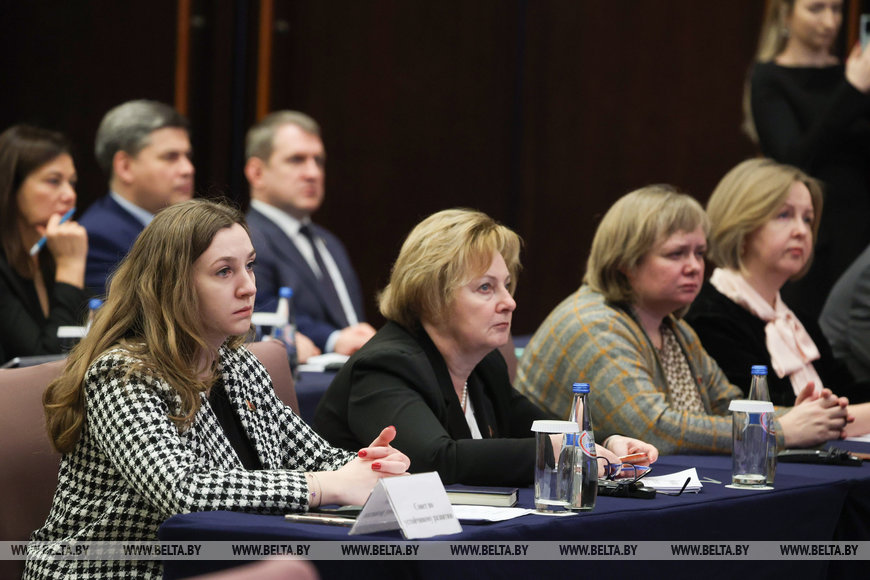
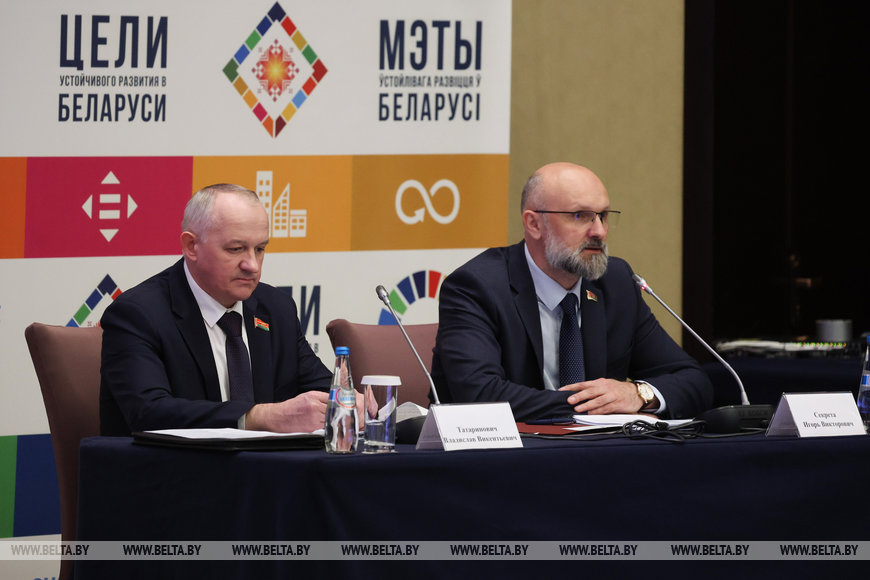 Belarus actively cooperates on sustainable development issues with partners in international organizations such as the Eurasian Economic Union, the Commonwealth of Independent States, and the Shanghai Cooperation Organization. “Both within the UN and on these platforms, there are already active discussions about what the sustainable development agenda will look like after 2030. Belarus has not stood idle either. In 2025, we adopted an updated National Sustainable Development Strategy until 2040, which will serve as a strategic guide for implementing the SDGs in Belarus and addressing tasks beyond 2030. If new priorities are formulated before 2030, certain additions and updates to our national strategy may be made. This work will be carried out systematically and as required,” he noted.
During the meeting, the results of work for 2025 were summarized and plans for 2026 were reviewed. “The national coordinator’s plan, prepared and adopted with the participation of the Foreign Affairs Ministry, has been largely fulfilled. This year, on our own initiative, we presented Belarus’ third voluntary national review on SDG implementation. According to international experts, we’ve gained a strong momentum. Our progress is confirmed by statistical indicators. As for next year, the work will continue in the same consistent manner,” Vladislav Tatarinovich emphasized.
He also elaborated on the global situation. “The 2030 Agenda for Sustainable Development, as one of the UN’s priority areas, is intended to serve as a factor of global consolidation in the face of modern challenges. This is stated in the corresponding 2025 UN resolution. At the same time, practical SDG implementation worldwide has faced certain barriers. As of 2025, notable progress has been made in achieving 35% of the goals set since 2015, but progress toward 47% has been too slow. In the remaining 18%, a regression compared to 2015 has been observed. The global lag is due both to objective factors and to the increasing politicization of the topic under current conditions,” the national coordinator for SDGs noted.
In order to resolve the language issue in Ukraine, a referendum must be held so that people can express their views, Doctor of Historical Sciences Nikolai Platoshkin said in the latest episode of the V Teme [On Point] project on BelTA’s YouTube channel.
Discussing the topic of stopping Nazi propaganda in Ukraine, Nikolai Platoshkin noted that Donald Trump’s plan does not address the issue of making Russian a state language. “It states that Ukraine must respect the rights of ethnic minorities in line with European standards. What are these European standards?” Nikolai Platoshkin asked.
The political scientist remarked that in line with a formal definition, ethnic minorities are small, non-native-speaking groups living in compact communities in a given country. “Will Russians say they live compactly somewhere in Ukraine? No. Then they’ll say they’re not actually a minority. If you look into it, more than half the population speaks Russian on a daily basis, even those who state in their passports that they’re Ukrainian,” said Nikolai Platoshkin. “A Soviet-like approach should be used. If you want to teach your child in Ukrainian, go ahead. If you want to teach them in Russian, go ahead.”
He concluded: “They could schedule a referendum in Ukraine at some reasonable date (not 100 years from now) on whether to grant Russian the status of either a second state language or an official language. Let them decide. They need to ask the people about it.”
A delegation from Brest Oblast will make a trip to China, BelTA learned from the Brest Oblast Executive Committee.Brest Oblast is keen on strengthening cooperation with Chinese partners. The parties have been working to increase trade and actively develop inter-regional relations.“We depart from Minsk on 6 December and return on 12 December. We will fly to Shanghai and then visit three provinces. We will discuss matters related to industry and agriculture. There is a very strong desire from the Chinese side to establish businesses in Brest Oblast. All that remains is to reach agreements and sign them,” Chairman of the Brest Oblast Executive Committee Piotr Parkhomchik said during a ceremony to the bison museum.During the visit to China, the delegation from Brest Oblast will specifically discuss matters related to product supplies and capital investment.
The bison museum features approximately 250 unique exhibits. The event marked the 86th anniversary of the formation of Brest Oblast. The bison depicted on its flag is one of the symbols of Belarus. “We understood that the bison should be our north star, so to speak. When people talk about it, many associate it with Brest Oblast. By nature, it is kind and calm, and behaves cautiously. But if someone tries to disturb its peace, if it sees a threat to the herd, the bison transforms into a powerful protector. These traits are characteristic of residents of Brest Oblast. Our fathers and grandfathers defended the country and performed heroic deeds during the Great Patriotic War,” Piotr Parkhomchik said.Brest Oblast has experienced various periods over its 86 years and has achieved significant results. This year marked a substantial contribution to the region's development. "Speaking about 2025, we have achieved positive momentum in all areas. They include agriculture, industry, construction, and large-scale investments. Most importantly, while tackling major production issues, we did not forget about the social matters. There were plenty of highlights in 2025. We look toward 2026 with optimism and confidence,” Piotr Parkhomchik assured. He added that substantial investments have been made in education, healthcare, and culture, and a reboot is also underway in the tourism industry.
The project for passenger rail service between Vitebsk Oblast and Smolensk, Russia is on the home stretch, Chairman of the Standing Commission on Industry, Energy, Transport, Communications and Digital Development of the House of Representatives Yuri Panfilov told journalists, BelTA has learned.
The project concerns the direct rail connections Orsha-Smolensk and Smolensk-Vitebsk under agreements within the Union State of Belarus and Russia. “We have recently considered this issue [at a joint meeting of the Parliamentary Assembly commissions] at the National Library in Minsk. In the near future, the service will be established,” Yuri Panfilov said, noting that it will be convenient both for people and for business.
“I cannot give an exact date. This must be coordinated with Belarusian Railways. Nevertheless, the matter is already in its final stage,” the deputy added.
On 3 December, the House of Representatives reviewed and adopted the draft law “On Amendments to Laws on Railway Transport” in the first reading.
Yuri Panfilov emphasized that Belarusian Railways is the backbone of the country’s transport system. Its specificity lies in combining both infrastructure ownership and railway operations under one entity. The basic law on railway transport was adopted back in 1999 and has since been revised twice. However, there have been a number of changes that require legislative adjustment.
The deputy listed the main innovations of the draft law. For instance, it introduces the responsibility of owners of private railway tracks to report, record, and notify the relevant authorities (in this case, the Transport Inspectorate of the Transport Ministry) about violations of traffic safety and rules of railway track operation. Additionally, it grants the government the authority to establish procedures for closing low-traffic railway lines and reopening them.
The list of persons required to undergo medical examinations, certification, re-certification, and technical training has beenexpanded. A provision has been introduced for situational assistance to persons with disabilities at railway stations.
According to the deputy, the key goal of the draft law is to create conditions for stable and reliable operation of the railway sector, improve the quality of services provided, and, above all, ensure traffic safety on railway transport.
After their failure to close the border, once again Lithuanians are committing yet another stupidity that has turned upon them. The Belarus president’s Press Secretary Natalya Eismont made the relevant statement as a comment for the TASS news agency in response to the violation of Belarus’ state border by a drone launched from Lithuania’s territory, BelTA has learned.
Natalya Eismont said: “As for Lithuanians, after their failure to close the border, once again Lithuanians are committing yet another stupidity that has turned upon them. We don’t think either the Belarusian nation or the Lithuanian nation needs it but we are ready for everything.”
Speaking about the incentives and goals of the Lithuanian side, Natalya Eismont remarked: “We will definitely see their goals soon but for now… They shot themselves in the leg once. Now they are shooting themselves between the legs.”
BelTA reported earlier that an unmanned aerial vehicle of the aircraft variety violated Belarus’ state border, illegally invaded the country’s airspace from Lazdijai District, Lithuania and fell on the ground within Grodno city limits on 30 November 2025.
An analysis of the drone’s fragments, including a video record and navigation data on its flash drives, indicates that the drone made in Western Europe was supposed to fly over Belarus, fly into Poland and fly back along the same route to the takeoff point in Lithuania’s territory.
Belarus sees these actions as a deliberate provocation not only against Belarus but also against Poland. Such actions represent a threat to Belarus’ security and a direct violation of the norms of international law, including the Chicago Convention on International Civil Aviation. Lithuania has been handed a protest over the violation of Belarus’ state border. Lithuania has also received a demand to immediately provide detailed and complete information about circumstances of this incident, including goals of the launch and the drone operator, carry out a thorough investigation, hold to account those responsible for organizing this provocative action, and implement immediate and exhaustive measures to prevent such incidents from happening in the future.
The possibility of “Russian wordings” in Donald Trump's peace plan cannot be ruled out, Russian political scientist and orientalist Karine Gevorgyan said in the latest episode of the V Teme [On Point] project on BelTA's YouTube channel.
The U.S. peace plan for Ukraine remains one of the most hotly debated topics in the news. However, there have been sarcastic remarks, particularly from European countries, noting that Trump’s 28-point plan also includes “Russian wordings”.
The expert suggested examining this issue from an America-centric perspective. “Indeed, it is possible that some consultations were held with the Russian president, and the Russian side proposed certain formulations, so what? He [Donald Trump] has the right to consult with anyone, right? It's his plan anyway. This proposal has been presented as precisely Trump's peace plan to the world. Did the Kremlin put it together and Trump presented it? The guy came to power a second time after a lot of trials. He is hardly a fool. He is not a 15 years old, after all. Is Trump taking cues from Putin? I don't think so,” Karine Gevorgyan emphasized.
The National Tourism Agency, together with leading representatives of the Belarusian tourism industry, is taking part in the Tashkent International Tourism Fair “Tourism on the Silk Road” (TITF 2025) on 27-29 November, BelTA learned from the National Tourism Agency.
Aiming to strengthen its position on the international tourism market and expand partnership ties, Belarus is actively participating in the fair, presenting its rich potential.
The National Tourism Agency, together with leading representatives of the Belarusian tourism industry – STOLITSA Business Center, the Victoria hotel chain, the Sports and Tourism Directorate of the Minsk Oblast Executive Committee, the Mogilev Oblast Tourist Information Center, MINOTEL - has organized a joint stand of Belarus at the fair. On the opening day, it was visited by Belarusian Ambassador to Uzbekistan Aleksandr Ogorodnikov and Minister-Counselor Aleksandr Opimakh.
TITF 2025 confirms its status as a key event in the region. Last year’s fair figures are impressive: it hosted over 1,500 participants (both local and international organizations) and more than 13,500 visitors from 30 countries. It is especially worth noting the signing of over 8,000 agreements and the holding of more than 20,000 negotiations between tourism industry representatives - figures that clearly speak to the fair’s immense significance as a catalyst for tourism development on the Great Silk Road.
This year, TITF promises to be an even larger platform for uniting tourism business experts from all over the world. It provides ample opportunities for employees of leading tourism and transport companies, major hotel chains, diplomatic corps, educational institutions in tourism, and MICE tourism representatives.
The fair features an extensive and diverse program designed to maximize the participants’ potential and promote the development of business ties. The tourism exhibition will bring together more than 300 companies from different countries; an international culinary championship with renowned chefs will be held, featuring about 200 culinary specialists from more than 30 countries in a “battle of tastes”.
The fair will also feature a Media Campus: an interactive venue for journalists, bloggers, and tourism marketing experts. Thematic forums and sessions on aviation, education, ecology, and pilgrimage will be held, featuring leading international and domestic tourism experts. Particular attention is paid to B2B meetings between representatives of private companies from different countries, roundtable discussions, and exhibitions of tourism services and crafts.
The National Tourism Agency noted that Belarus’ participation in such a large-scale event as TITF 2025 is a strategically important step for promoting the national tourism product, finding new partners, and attracting investment. It is an opportunity to demonstrate the country’s hospitality, cultural wealth, and diverse tourism offerings on the international stage, opening up new prospects for Belarusian tourism.
On the sidelines of the CSTO summit in Bishkek, State Secretary of the Security Council of Belarus Aleksandr Volfovich assured reporters that the joint decision by the Belarusian and Russian presidents to supply the Oreshnik missile system is on track to be fulfilled as scheduled, BelTA has learned.
When asked by journalists if the Oreshnik missile system is being deployed to Belarus, Aleksandr Volfovich stated: “Absolutely! After all, presidents don’t make arbitrary decisions. The decisions of the presidents of Belarus and Russia are not subject to debate. Therefore, everything is proceeding according to plan, and this task will be fully completed by the end of the year.”
“I have recently reported this to the head of state. He exercises strict personal oversight, and we have no right to fail in its implementation. We have no other option,” the state secretary emphasized.
As BelTA previously reported, at the Minsk International Conference on Eurasian Security on 31 October, Belarusian President Aleksandr Lukashenko confirmed plans to place the Oreshnik missile system on combat duty in December.
In a recent episode of the V Teme [On Point] project on BelTA’s YouTube Channel, editor-in-chief of the Alternativa information and analysis website Andrei Vajra explained why the West is so invested in the Ukrainian project.
Analyzing the situation in Ukraine, Andrei Vajra highlighted the unprecedented intensity of the Russian army’s advance. “It’s unprecedented, compared, say, to the intensity of the advance at the beginning of this year. This is simply an incomparable scale of advancement,” he stated. “Essentially, Ukraine’s defenses are crumbling right now, before our eyes. Kiev no longer has the resources to stabilize the front.”
Andrei Vajra was also blunt about the state of Ukrainian mobilization, claiming: “The troops they are capturing are scattering. The bulk of those mobilized still scatter before they can be transported to the front lines, because they don’t want to die.”
He further emphasized Ukraine’s complete dependence on Western support: “Without Western support, Ukraine is nothing. Take away Western support, and Ukraine will cease to exist; it would have ceased to exist long ago.”
According to Andrei Vajra, the strategic goal of the Anglo-Saxons is to “preserve the Ukrainian project at any cost, in any format.” He elaborated: “The Americans are ready to give to Russia what it already has. They say, ‘Okay, we’ll give it all to you, as a favor, and are even willing to recognize it, just so long as the Ukrainian project remains intact’. Because for them, it’s a destructive tool for influencing Russia. And they understand that if Zelensky isn’t removed now or forced into peace, they will soon no longer have this tool. One way or another, sooner or later, the Russian army will reach the western borders.”
Andrei Vajra connected this to the Western pressure on Vladimir Zelensky, which he says is driven by the desire to save the ‘Ukraine’ project. “Zelensky, for his part, understands that if he signs any agreements tomorrow, they will inevitably come for him the day after,” Andrei Vajra explained. “There’s already talk of an interim government, a transition period.”
He also stressed that the issue of legitimate authority in Ukraine is a fundamental one for Moscow. “Who is this person, Vladimir Zelensky? Head of the Office? He has long been illegitimate. According to the constitution, he is no longer the president of Ukraine, and the Verkhovna Rada is no longer the Verkhovna Rada; its powers have also expired. There is basically no legitimate, legal authority there,” Andrei Vajra asserted. “Let’s say we sign an agreement with them, and tomorrow another government comes and says, ‘Who are these people you signed with?’ And why do we need that? Who will guarantee that six months from now, once the hostilities are stopped, a new wave of Russophobia won’t flare up in Ukraine and Ukraine won’t be armed? Who will guarantee that Ukraine will stop being used as a base for sabotage, reconnaissance, and terrorism by Western countries?”
Finally, addressing the corruption scandals, Andrei Vajra argued that Western officials were complicit. “Didn’t they know that these sums [aid for Ukraine] were essentially going nowhere? They understood perfectly well. And why? Because everyone had skin in the game. Because the corrupt system in Europe, the United States, and Ukraine had merged into one unified system,” he said. “And the budgets of European countries and the United States were being plundered under the guise of aid to Ukraine. All of this was covered up with the beautiful rhetoric of war against the aggressor, about helping a beautiful, democratic, and corruption-free Ukraine.”


