222357, Minsk, Svobody square, 2
Reception phone number: Operating mode:from 8.00 to 13.00 and from 14.00 to 17.00 on weekdays
e-mail: This email address is being protected from spambots. You need JavaScript enabled to view it.
hotline: +375 (1772) 5-55-72

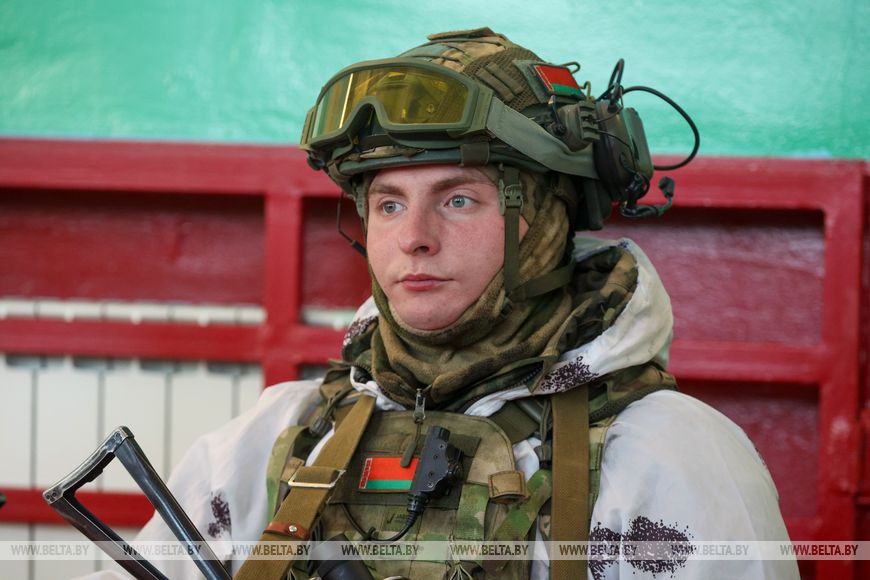
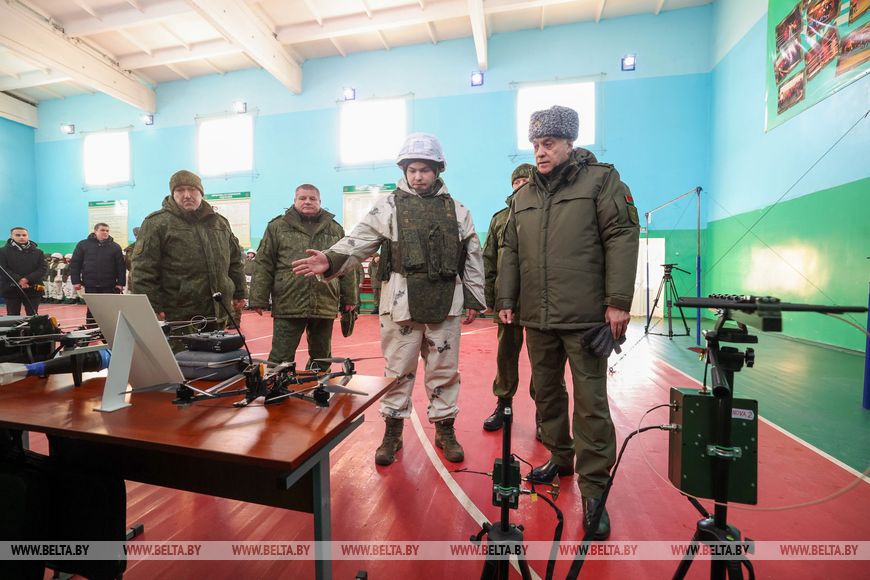
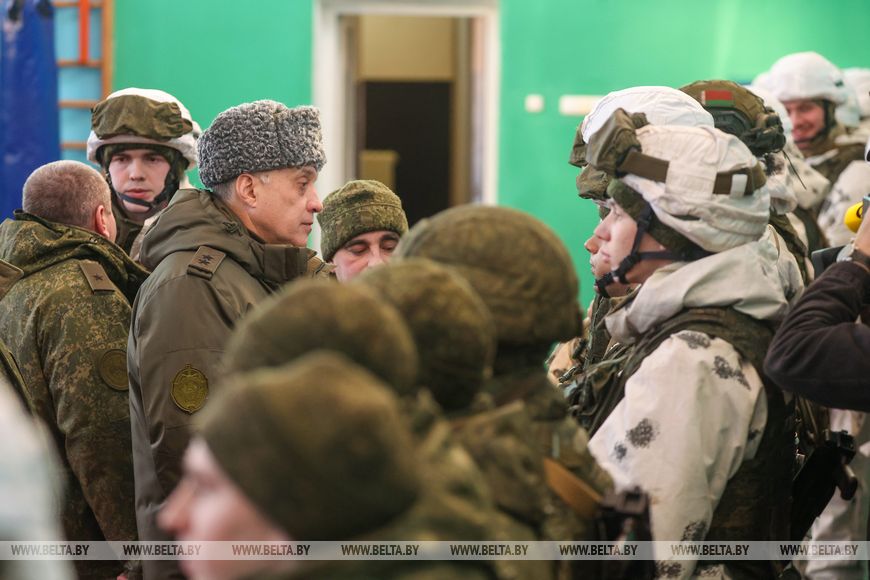
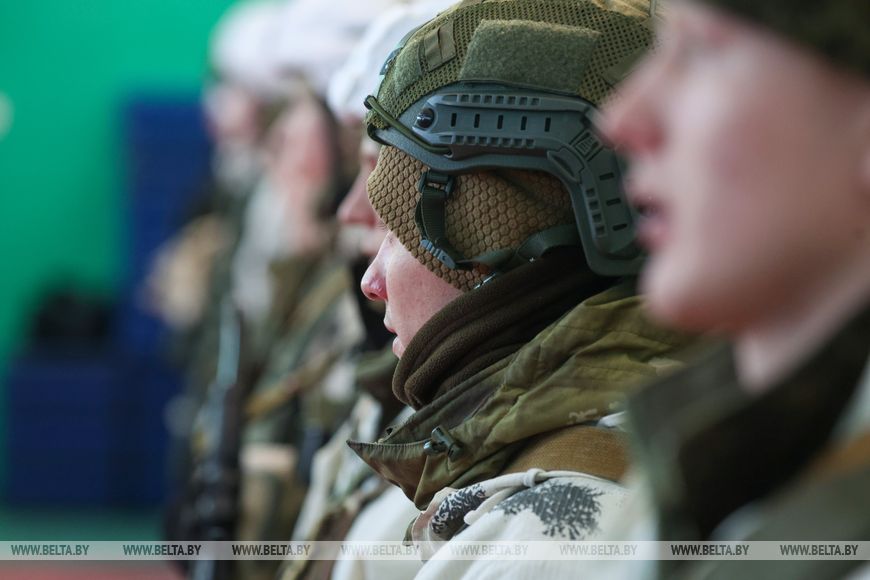
The 38th Independent Guards Air Assault Brigade based in Brest has been put on heightened alert as part of the ongoing combat readiness inspection of the Belarusian army authorized by the president, BelTA has learned.
Sergei Kuprik, Advisor to the State Secretary of the Security Council, noted: “In accordance with the plan on inspecting the Armed Forces upon the decision of the head of state today we are bringing individual units of a special operations forces formation to the highest degree of combat readiness. Once the units are ready for combat deployment, they will have to carry out their assigned missions in a complicated tactical environment. After that every servicemen and respectively every unit will be evaluated based on results of shooting tests and physical fitness tests.”
In particular, the military personnel will have to demonstrate their ability to shoot all kinds of weapons and will have to pass endurance and strength tests.
Valery Bulygo, commanding officer of the 38th brigade, has given instructions to unit commanders regarding consequent fulfillment of assigned missions.
The Belarusian Special Olympics delegation received official participant medals at the Open Masters Games in Abu Dhabi. They were presented during a team reception at the Belarusian Embassy in the UAE, BelTA has learned.
For the entire team, the meeting with Belarusian diplomats was a true celebration. The warm support from their compatriots is palpable, providing an energy boost ahead of the competitions at the Zayed Sports City Arena in the UAE capital, Larisa Tabolina, the head of the delegation, said. She also mentioned that besides the official reception, the Belarusian diplomats prepared an interesting cultural program. The guests visited Abu Dhabi’s most vibrant and iconic locations before heading to the shores of the Persian Gulf to relax. The athletes and coaches said the day felt like a fairytale – they experienced the city’s unique architecture and history, and the sunny seaside proved an ideal place for a mental recharge after intense training and competitions. Such support from their compatriots allowed the team to feel at home, despite being thousands of kilometers away. The Belarusian diplomats wished the athletes luck, emphasizing that their participation in the Games is not just about sport, but a mission showcasing Belarus’ strength and inclusivity to the world.
The Games spotlight inspiring human stories, with athletes aged 30 to 90 competing in the UAE capital. At the Open Masters Games in Abu Dhabi, Belarusians will contend for medals in athletics events, including various distance races, high jump, long jump, hammer throw, and shot put. The Belarusian delegation includes students from the Glusk Children’s Social Boarding Home Vesnovo. This is a social service institution for children with disabilities and young adults with special psychophysical development needs. Brothers Oleg and Aleksandr Medovsky, Anna Pestova, Alesya Poznyak, and Grigory Dyuvbakov will take to the sporting arenas. Their coach, Aleksandr Petrov, has been actively promoting the ideals of Special Olympics for over 30 years. Despite life’s challenges, these individuals remain open, disciplined, and incredibly positive - a shining example of how hard work and a coach’s support can turn dreams into world-class medals. Belarusians are competing at these events thanks to the long-term cooperation between the Presidential Sports Club and the Belarusian Special Olympics Committee.
The Open Masters Games Abu Dhabi 2026 is the largest multi-sport event of its kind. It involves over 25,000 athletes from more than 120 countries, who will compete for medals in 33 sports. Among these are football, basketball, volleyball, rugby, athletics, swimming, cycling, tennis, badminton, judo, karate, Muay Thai, sailing regattas, and canoe races.
Scientists from Belarus and Russia are developing innovations to enhance the lifespan of spacecraft, Chairman of the Presidium of the National Academy of Sciences of Belarus (NASB) Vladimir Karanik told the media prior to a NASB meeting to discuss the Union State programs, BelTA has learned.
“Today, we are taking stock of the programs in 2025 and discussing prospects for 2026–2030. I can say that we approached this meeting with strong results. Currently, we are running the Union State programs focusing on the most pressing issues in scientific, technological, and innovative activities. These include microelectronics and photonics, space exploration research, and biotechnology. While concrete hardware products for space research, microelectronics, and photonics have already been launched into orbit, the Union-Biomembranes program is expected to yield significant achievements in medicine and other fields," Vladimir Karanik emphasized.
As part of the comprehensive inspection of the combat readiness of Belarus’ Armed Forces a combat shakedown of army units made up of people subject to military service is taking place in a military training area, representatives of the Belarusian Defense Ministry told BelTA.
Leonid Kasinsky, the Defense Minister’s Aide for Ideological Work in the Armed Forces, Chief of the Central Office for Ideological Work at the Defense Ministry, went to the military training area. He talked to the conscripts and was made familiar with the accommodations available to the personnel.
“People are motivated and focus on fulfilling their missions. It is the key. I haven’t heard any complaints from anyone. The people are fully satisfied with the conditions and with the accommodations available in the military training area. They are constantly busy training in the field. And certainly, it inspires confidence that our country has nothing to fear with this kind of people subject to military service,” the officer said. “I remember when in the early 2000s the first people subject to military service were recalled to active service after a lengthy period of no inspections in the Armed Forces. The mood of the conscripts and actions of the officers in that period were incomparable to what we have now. The officers that have been recalled from the reserve confidently accomplish the missions assigned to their units. The personnel, soldiers, and sergeants are adults, serious people. Certainly, some of the guys finished their military service two years ago. At the same time one can feel from the very first days that this team, that this collective is capable of accomplishing any task.”
“And the key thing is that they understand that these surprise inspections are just necessary in the conditions that evolve around our country today. The people understand that nobody else can defend their families and loved ones, their homes, their own country,” Leonid Kasinsky added.
He also remarked upon the attitude of the families of the people subject to military service to the organization of such training sessions: “Certainly, the wives worried for the first few days. Several days later in phone calls things were explained to the families. Everyone showed understanding. There are no problems. Apart from that, we have a hotline. Wives and mothers of any person subject to military service can call it and formulate their problems. There were no calls in the last few days. It is a clear testimony of the fact that the families have the right attitude to those, who defend their own country.”
At the invitation of the House of Representatives, a parliamentary delegation from Kazakhstan, led by Chairman of the Mazhilis of the Parliament of the Republic of Kazakhstan Yerlan Koshanov, is paying an official visit to Belarus on 4-5 February, BelTA learned from the press service of the House of Representatives.
Chairman of the House of Representatives Igor Sergeyenko met the delegation at the airport.
Kazakhstan’s MPs are set to hold a series of meetings and negotiations, to tour enterprises and to visit the memorial sites associated with the Great Patriotic War.
Belarusian Education Minister Andrei Ivanets and Russian Science and Higher Education Minister Valery Falkov signed an intergovernmental agreement on the conditions of the Belarus-Russia University (BRU) operation. The ceremony was held via videoconference, the press service of the Belarusian Education Ministry told BelTA.
The agreement marks a new stage in the education and science development of the Belarus-Russia Union State. BRU is a major regional research and educational center to train engineers for the real sector of the economy. Around 5,000 students study at the university across 28 Belarusian and 15 Russian academic programs. On 19 January 2026, the university celebrated its 25th anniversary. It looks confidently to the future.
The document will expand the training of highly qualified specialists for the economies of both countries, develop networked educational programs (projects are already underway with Peter the Great St. Petersburg Polytechnic University, Belarusian State Technological University, and other universities). It will also strengthen scientific and technical cooperation, including projects in additive technologies, robotics, and industrial AI, and create conditions for new laboratories and competence centers.
BRU continues its transformation into an international center for integrating education, science, and digital technologies, aimed at ensuring the technological independence of Belarus and Russia.
Photo courtesy of Belarus' Education Ministry
Dancing is one of the fun activities to enjoy with friends on long winter evenings.
On 31 January the State Museum of the History of Belarusian Literature invited Belarusians of different ages and professions united by a love for music, dance, and Belarusian traditions for a dance evening. Experienced dancers helped those present get acquainted with the basic movements of various dances.
Accompanied by the violin, cimbalom, accordion, drum, and other instruments, the enthusiasts had fun dancing Lyavonikha, Krakoviak, Hrachaniki and Kakhanachka.
One phase of the snap inspection of the Armed Forces, conducted on the president’s order, has been completed, State Secretary of the Security Council of Belarus Aleksandr Volfovich told the media on 30 January, BelTA has learned.
“Today, one phase of the snap inspection of the Armed Forces, conducted on the order of the president, has been completed. This stage included checking the combat readiness and combat capability of the 19th Separate Mechanized Brigade in fulfilling tasks according to its combat designation. The inspection took place under challenging weather conditions – severe frost, snow, and freezing rain. This affected the progress of completing the assigned tasks and control exercises. However, the brigade’s personnel successfully fulfilled the task set by the president. They worked through all the issues put forth for inspection: bringing to combat readiness, loading material resources, conducting a march over rough terrain, moving into an assembly area where control exercises in combat training subjects were conducted. The results the servicemen demonstrated are positive,” Aleksandr Volfovich said.
As BelTA previously reported, a large-scale inspection of the Armed Forces on the instructions of the head of state began on 16 January. Aleksandr Lukashenko is personally monitoring its progress. A new system has been implemented that allows the president to directly place military units on combat readiness, circumventing the Defense Ministry and the General Staff. The main aim of these inspections is to gain an objective assessment. This is precisely why they are carried out without prior notice.
Restrictions and bans on traveling to Belarus will have the opposite effect on Latvian citizens, and they will want to go to the country themselves to see how people actually live there, former Latvian MEP, media expert and journalist Andrey Mamykin told BelTA while commenting on the strict restrictions of the Latvian side for its citizens to travel on tourist buses.
The expert believes that the effect will be exactly the opposite of what the Latvian authorities expected. "Strangely enough, this will have the opposite effect, because the forbidden fruit is sweet. I remember being a young man: while the Voice of America was banned, I always listened to it on the sly, secretly from my communist grandfather. And when they allowed these things, chewing gum and Coca-Cola, I realized what nonsense it was. Very soon, the Balts will want to feel, see and get to know the Republic of Belarus firsthand. Naturally, they will leave with many positive impressions, because Belarus has those objective criteria and positive aspects that are missing in Latvia," Andrey Mamykin is convinced.
He added that another important aspect in our country is the administrative flexibility due to its compact size. "Belarus, being a small and compact country, has a high speed of maneuver. What I mean is this: when a foreigner comes to Belarus and applies for a residence permit, your authorities distinguish whether the person was convicted under a political article or a criminal one. Those who arrive with political convictions, in particular from Latvia, people who suffered for freedom of speech, receive asylum in Belarus," he explained.
Belarus and China will step up cooperation in standardization on a bilateral level and within the Shanghai Cooperation Organization (SCO), BelTA learned from the press service of Belarus’ State Committee for Standardization.
The legal framework of Belarus-China cooperation in technical regulation comprises 13 documents, including an agreement on cooperation in the reproduction and dissemination of standards, an agreement on cooperation and a memorandum in standardization, metrology, conformity assessment and accreditation, as well as other agreements, including those at the level of national institutes in standardization and metrology.
Bilateral cooperation in these areas has intensified significantly over the past two years. In particular, on 31 August 2025, as part of the head of state’s visit to the People’s Republic of China, a memorandum of understanding between the State Committee for Standardization and China’s State Administration for Market Regulation (SAMR) on cooperation in ensuring measurement uniformity and a memorandum between the Belarusian State Institute of Metrology and the National Institute of Metrology of China on mutual understanding regarding cooperation in metrology were signed.
In addition, in 2025, specialists of the Belarusian State Institute of Metrology underwent a training internship at the National Institute of Metrology of China in Beijing, where they completed a training course and practical training in various areas. The participation of State Committee for Standardization representatives in the first conference on standardization cooperation of the Shanghai Cooperation Organization, held under the chairmanship of China in Qingdao in July, gave an additional impetus to the practical deepening of cooperation between the State Committee for Standardization and SAMR in standardization. The conference resulted in Belarus joining the Qingdao initiative to strengthen cooperation in standardization between the national standardization bodies of the SCO countries.
Cooperation continued with the State Committee for Standardization taking part in the China Quality Conference in Nanjing in September 2025. On the sidelines of the forum, Belarus and China signed an agreement on cooperation in standardization. The updated document makes it possible to develop cooperation mechanisms between member states and observers of the SCO in standardization, harmonize approaches to the development and application of standards, and create favorable conditions for the development of innovations and the exchange of best practices.
China’s current quality strategy is fully in line with Belarus’ approaches to the development of the quality of Belarusian products, Belarus’ State Committee for Standardization noted.
In 2026, work to improve the legal framework in technical regulation, which contributes to the further development of trade and economic cooperation, will continue both on a bilateral level and within the framework of the plan of joint actions of the national standardization bodies of the SCO member states. This plan, in particular, provides for the establishment of a meeting of heads of standardization bodies, the creation of a working group on cooperation in standardization and quality infrastructure in general, as well as thematic expert groups in key areas of cooperation, including metrology, accreditation, conformity assessment. Their work will make the development and application of standards even more effective and in demand.


